
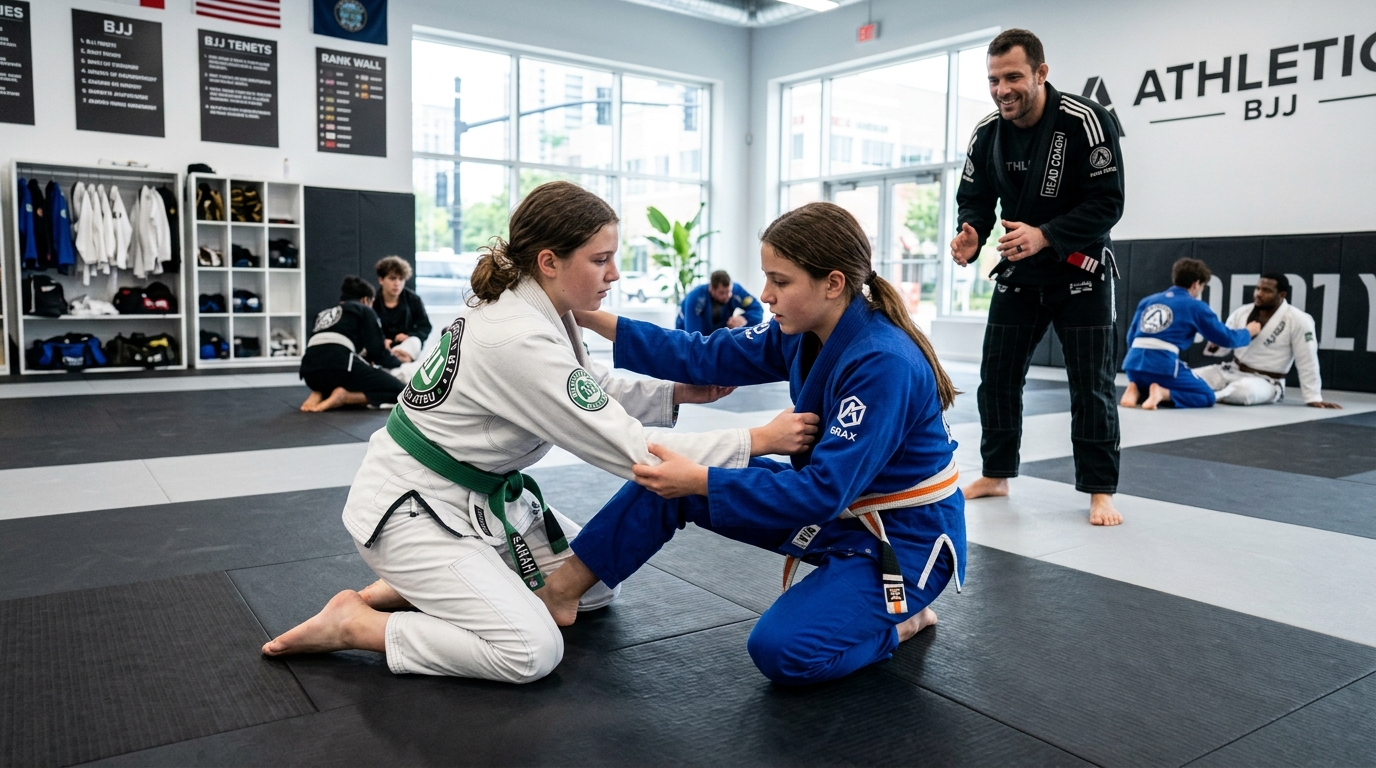
Your teen still enjoys Jiu-Jitsu, but the kids’ class no longer feels right. Their partners seem smaller, the activities feel young, or they want more challenging practice. Yet joining a room full of adults feels like too much.
Start by asking the coach about a teen class and suitable training partners. Size, experience, self-control, and comfort all matter when choosing the next step. At Ascended BJJ and Boxing, we offer a dedicated teens program, giving families an option between younger children’s classes and adult training.
How can you tell whether your teen has outgrown kids’ BJJ?
Look for a repeated mismatch in partners, instruction, or social fit. One frustrating class doesn’t tell the whole story.
Their training partners no longer fit
Your teen may spend much of class holding back with smaller children. Ask whether the coach can provide partners who offer useful practice without a large physical mismatch. Being the biggest student doesn’t necessarily mean being the most skilled.
Their lessons no longer challenge them
“It’s boring” needs a follow-up question. Does your teen want harder techniques, more practice, or classmates closer to their age? Repeating a basic move still has value, but the instructor should explain what your teen needs to improve.
Their social needs have changed
A teenager may enjoy BJJ while feeling uncomfortable in a group of much younger children. Ask privately: “Would you still want to train if the class had more people your age?” That answer helps separate a class-fit problem from losing interest in the sport.
Does being bigger mean a teen should train with adults?
Body size alone cannot determine class readiness. A tall beginner still needs basic instruction. An experienced smaller teen still needs suitable partners and manageable training intensity.
The American Academy of Pediatrics advises considering body size and physical maturity alongside age when matching young people in contact sports. Its guidance also recognizes physical, mental, and social readiness. Read the sports-readiness guidance.
Use these questions to guide a conversation with the coach:
| Factor | What to ask |
|---|---|
| Experience | Can my teen follow the lesson and practice the basics? |
| Control | Can they manage their strength and follow instructions when frustrated? |
| Partners | Who can train appropriately with their size and experience? |
| Confidence | Will they speak up if they feel uncomfortable or confused? |
| Eligibility | Does the academy’s age policy allow this class? |
For example, a strong 13-year-old beginner may need more introductory support than a smaller teen with several years of training. Neither student’s height answers the placement question.
How can a teen BJJ class bridge the gap?
A teen class can combine more demanding learning with an age-appropriate peer group. It gives teenagers room to develop without making adult training their only route forward.
Brazilian Jiu-Jitsu is a grappling martial art. Students learn to control positions, escape holds, and use technique during close-contact practice. A useful teen program should help students understand what they’re practicing and how to work responsibly with a partner.
More challenge with clear guidance
Look for instruction that explains the purpose behind a move. Can students ask questions? Does the coach help them correct mistakes? Detailed feedback matters more than whether a class simply looks intense.
Peer connection with suitable partners
Training with other teenagers can make the class feel more relevant. However, a “teens” label doesn’t guarantee a suitable partner in every session. Ask about the students who usually attend the class your family can reach.
At Ascended, our values include age-appropriate instruction, respect, and progress beyond belt promotions. Our instructor team includes Kids & Teens Instructor James Petroski. These are useful starting points when you’re comparing Brazilian Jiu-Jitsu in Kingston, NY.
In a review featured on our website, Christina Batch-Lee describes a supportive community where her whole family trains. Use parent feedback to shortlist a school, then see how the actual class fits your teen.
What should parents ask before changing classes?
Ask how the proposed class will solve your teen’s specific difficulty. “They’ll get used to it” leaves too much unanswered.
Ask about partners and supervision
- Who would my teen usually practice with?
- How do you account for differences in size and experience?
- What happens if a partner uses too much force?
- Who should my teen approach if something feels wrong?
Ask about the training progression
“Drilling” means repeating a technique with a cooperative partner. “Rolling” means live practice against a resisting partner. Ask when rolling begins, how the coach introduces it, and which techniques the class permits.
The American Academy of Pediatrics emphasizes supervised skill development before progressing to sparring or contact. In BJJ, clarify how the coach moves students from learning a technique to practicing against resistance. See its martial arts guidance.
Ask about an unsuitable first placement
Can the coach reassess the class if your teen struggles? What alternatives exist within the academy’s age policy? Agree on a check-in rather than treating one trial as a permanent decision.
If you’re comparing BJJ classes near Woodstock, ask these questions before making the trip. Confirm the relevant session and expected training group, as well as the timetable.
How can you help your teen settle into a new class?
Give your teen a clear introduction and a chance to discuss the experience afterward. Avoid making the move sound like a test of toughness.
- 1. Explain the difficulty before class. Tell the instructor whether the concern involves smaller partners, boredom, confidence, or adult training.
- 2. Choose one learning goal. Following a new drill or asking for help gives your teen something useful to focus on.
- 3. Ask specific questions afterward. “Did the coach explain things clearly?” reveals more than “Did you win?”
- 4. Review the fit together. Discuss what felt challenging, what felt uncomfortable, and what needs to change.
New classmates and unfamiliar exercises may feel awkward at first. Repeated rough treatment, ignored requests to stop, or humiliation call for immediate attention. Don’t dismiss those concerns as normal adjustment.
What if adult BJJ still feels too intimidating?
Talk to the instructor about the exact concern before deciding to stop training. Your teen may worry about partner size, making mistakes, or being the youngest person in the room.
Our adult Brazilian Jiu-Jitsu program welcomes beginners as well as experienced students. That doesn’t remove the need to discuss placement and support for a younger newcomer.
If your current academy cannot offer a suitable group, compare another program. For families seeking a Brazilian Jiu-Jitsu academy near Woodstock, our Kingston location offers a dedicated teen option to explore before committing.
Request your teen’s free session at Ascended BJJ and Boxing, 307 Wall Street. Tell us what isn’t working in their current class so we can discuss the next step.
FAQs
Yes. Ascended welcomes beginners. Share your teen’s age and experience so our team can discuss the appropriate starting class.
No. Our teen program welcomes different fitness levels. Tell the instructor about any limitations before the first session.
Ascended recommends at least two classes weekly for steady progress. Choose a routine your teen can maintain alongside school and other commitments.
Wear comfortable athletic clothing, such as a T-shirt and shorts or sweatpants. Ascended’s first-class guidance says students don’t wear shoes on the mats.
Ask our team before booking. Confirm each teen’s eligibility and available trial spaces rather than assuming both can attend the same session.
Yes. Ascended offers a free session so your teen can meet the instructors and experience a class before deciding.